Featured image © David Bennett
All windows were open and all fans fully powered as eighteen intrepid members joined the hottest meeting of the year on Wednesday, 8th July. Twelve participants showed their work; the theme was ‘Rest’, and images were also shown from personal projects and tentative exhibition entries.
© David Helms
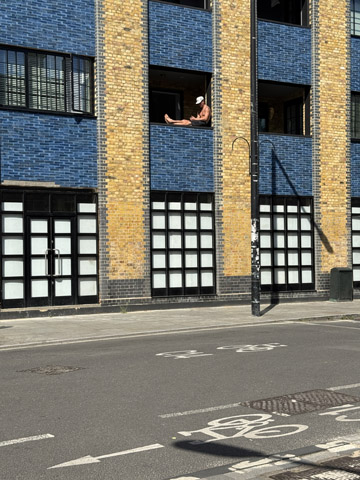
David’s images contrasted machine, people and animals at repose. A boat on the Thames, a survivor of better days, leans at an angle against a quay, keel exposed and vulnerable. A staircase becomes seating for a disparate group, occupied and unaware of the image they have become. A man in a window rests in full sun, framed by blue ceramic brickwork above and below – an image David waited patiently to capture to avoid the man staring at the lens. Two pigs are pressed tight in delicious sleep, muddied snouts and porcine pink. David’s final image is a swan with its cygnets, the parent a study in elegance and clean, white curves, offset by the fuzzy grey of its young. The overall effect of the selection is warmth and calm, quiet moments under summer sun.
© Bernard Creely
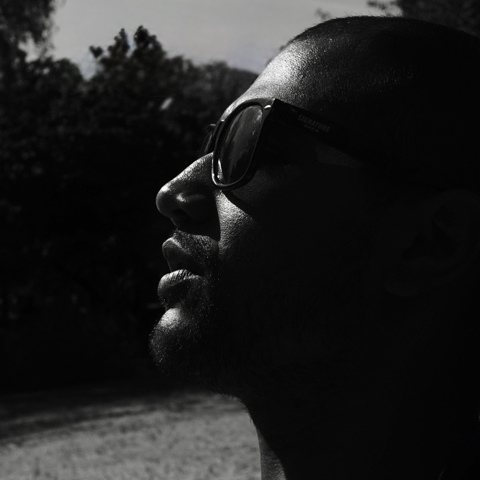
Bernard mixed street images and portraits to illustrate ‘rest’. A candid shot from a bus passing Westminster Abbey captures a man and a woman in conversation; he is leaning against the railings, the bus’s movement captured in dynamic blur. A man begs on Millennium Bridge, framed by the metal edge of the glass panel he leans against, a halo of dirt on the pane as an informal vignette. A woman relaxes in a chair, seen only from beneath the eyes, a rosette tattoo on her calf a source of colour in a deliberately dark image. She holds her hands in symmetry with her crossed legs; a bold image, cropped tight so she fills the frame. The final shots are of friends – a handsome man in profile, sunglassed and sharp, sartorially and technically. Bernard’s final shot is a friend, Kathy, eyes closed as she reclines post-walk, curls crowning her face, peaceful and perhaps at ease with the world and her place in it.
© Soraya Cerio
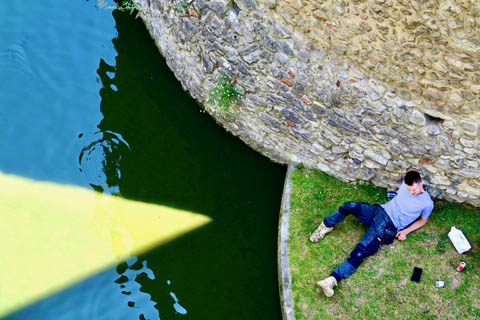
Soraya presented five images of Londoners, mostly in familiar settings, with a more questioning and enigmatic final frame. In the first a family sits beside the canal off Granary Square, a solitary woman set apart and thoughtful in the opposite corner. A workman rests by the same canal in the second, a perfectly captured triangle of reflected sunlight on the water pointing the way to him. A man surveys the Thames, leaning on a rail above steps to the foreshore, algae coating the polished stone beneath him. A woman, the composition skilfully beheading her with a hedge, lies on a bench amongst the flora, the inevitable phone held above her as distraction. The final shot is deliberately ambiguous – a man lies on the pavement, a copy of Price and Prejudice beside him (why? Why not) and the polished boots and institutional blue of police in crowd management chic clustered around him. Is he unconscious? Is he under arrest? Is this his personal protest, or the rest he earned? The photo was taken at a demo, making an otherwise ambiguous scene more tense, more urgent.
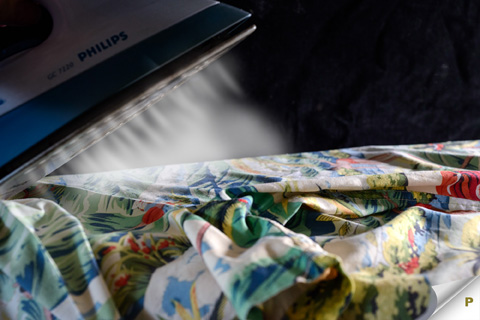
© Simon Zebu
Simon Zebu took us through a selective alphabet, with ‘rest’ nested within each title, invoking a call and response to reveal each. Playful imagery befitted the approach – including a gentleman ‘invited’ to sit in the back of a police van, the Dutch embassy’s splendid crest, and (with some poetic licence to ‘rest’) clothed viewers admiring a painting of the undressed. An iron hisses steam, the cloud suspended perfectly in the process of cloth being pressed. A chicken breast, a forest and a shot into a restaurant, a confused woman wondering why she is being caught unexpectedly in the foreground, close out the alphabet of rest. Each image stands on its own, but word association added a little sass.
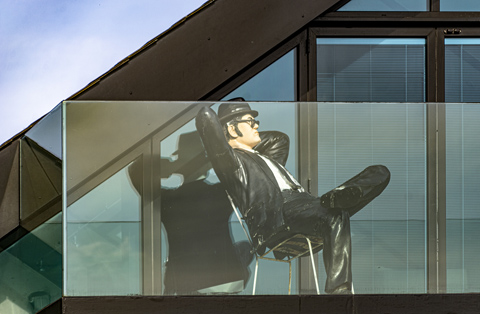
© Nusse Mechthild Belton
Nusse presented statues, stony and corporeal, as the ultimate expression of rest. A mannequin sits in a chair on a Richmond balcony, overlooking the river path, incongruously dressed as Elwood from the Blues Brothers. A statue lies on a boat. A scarecrow lies supine on the grass it should be raised above. A weathered angel in a cemetery guards a soul at rest. A bumblebee, exhausted by her work, lies a while within a white poppy, petals as cotton sheets. The final image embodies calm – a Norwegian landscape, mountains layered into the distance in a balanced black and white contrast, offering a coolness and serenity unavailable in London on that night.
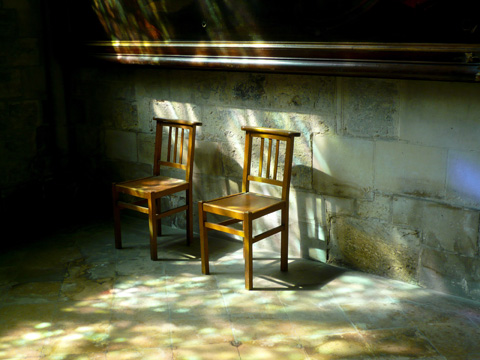
© James Cashmore
James offered two final expressions of rest. A cow reclines on a South Asian street, oblivious to the people and vehicles passing, perfectly content that this is the appropriate spot for a quiet moment. The shot is wide angle, placing the cow as a perfectly typical encounter for those shuffling by. The final image shows two empty chairs lit through stained glass in a cathedral. The stone glows in the warm angled light of afternoon, the chairs offering a peaceful corner in which to reflect.
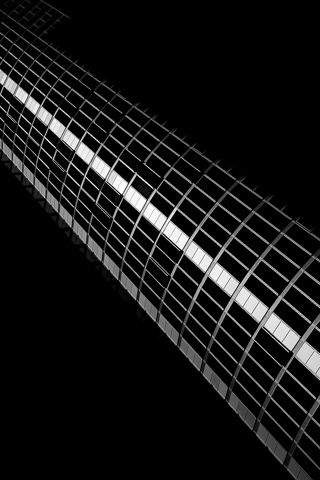
© Richard Pearce
Richard’s project presented architecture in abstract black and white, employing angles, cropping and heavy contrast to present the familiar built environment as art. His first image reveals the Olympic Aquatic Centre framed by an ominous sky, the façade’s wooden ridges glowing in direct sunlight. Skyscrapers in Vauxhall are presented at an angle to accentuate sharpness in the first, and a cropped shot of a black and silver grid pressed into a cylindrical tower, again shown obliquely, in the second. Two shots of Coal Drops Yard play with perspectives to place a curved walkway’s organic lines against a hard white sky, while a nearby building points a sharp fin upwards, one side in harsh sunlight, balanced by layers of varied contrast on the other. An atrium appears as an extended matrix of verticals and horizontals leading off into the distance. A final image uses the sharp facing edge of another skyscraper to create interest in the contrast of harsh and dark light, demanding we examine the building as something unfamiliar for that instant.
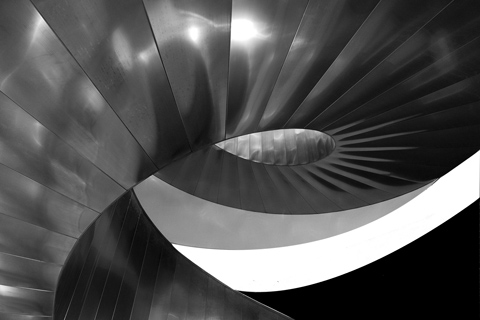
© Julian Sainsbury
Julian’s project juxtaposed sharp and curved edges, layered to create a sense of depth. The first images are spirals, suggesting the golden ratio as they flow away from the edge (or spin out from the centre…) as a gradient of black and white. The next set of images combine metallic blades as curves within a white circular frame. In some the metal is pitted with rust to an organic hue, each layer drawing the eye further into the cylinder. The images are not cropped to a template, but as shot, so the frame we see is how the work was created, an original approach that made dynamic images from the combination of perspective and materials.
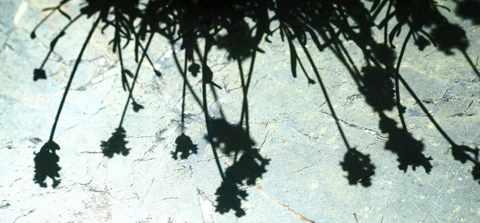
© Edith Templeton
Edey presented five images to show the interconnection of nature and the urban landscape, creating a fragile beauty in the contrast. Some feature the shadows of lavender on the stone floor of the Aga Khan Centre at King’s Cross. The stalks appear pressed into the stone, fossilised by its unforgiving surface, but retaining their identity. Edey has captured new forms in the shadows cast, abstract and yet identifiable as the organic projected against the cold and inert surface of the city. The final image of tree shadows on concrete panels can be read as nature finding its niche in the city, refusing to be subsumed. The natural remains visible above the manmade.
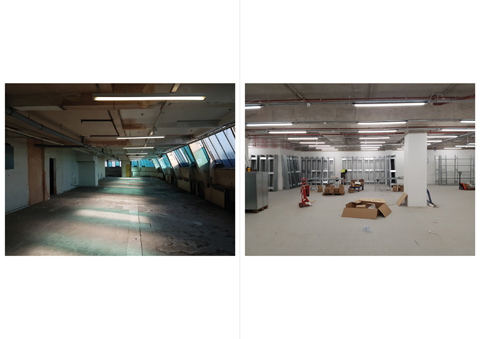
© David Bennett
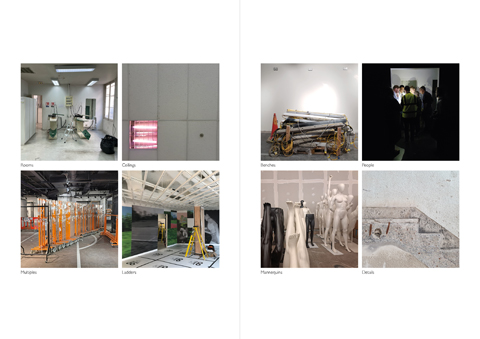
David’s project draws on his profession as an interior designer to offer both the opportunity and the inspiration for a fascinating, and often abstract, exploration of buildings evolving into new roles. Many of the images are diptychs, not necessarily of a shared space or them, but balanced by their palette or shape. The functional becomes surreal mid-transformation – an army of mannequins waits silently for orders, artificial light illuminates mysterious hanging bags. Sealed boxes fill an otherwise empty room, harshly lit by LED strips – do they contain the mundane or something compelling? These are an intriguing set, making the most of David’s access to create a series of images that are at times bizarre, always interesting in how they portray these liminal spaces.
Bernard presented a proposal for the forthcoming Connected/Disconnected exhibition – a series of over 200 images, shot as a burst, of a starling murmuration, then merged as an animation. Each starling follows the path of its neighbours within the flock, minutely altering its trajectory in a pattern that ripples through the murmuration. It provides the illusion of a single organism, morphing amoeba-like across the sky, connected apparently telepathically but responding, appropriately, to multiple visual signals. The disconnection comes through breaking the sequence down into its constituent images, each capturing a millisecond of the overall ebb and flow, while the connection of the starlings flows through each frame.
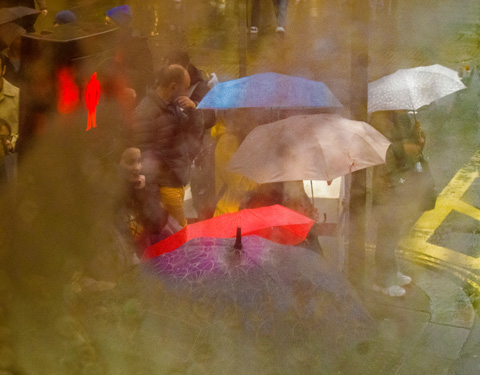
© Chris Burrows
Chris’s project reminded us that water once fell frequently from the heavens in this country, while we swelter beneath cloudless skies. Each image surrenders to the rain – blurred views through a pub window of pedestrians clutching umbrellas, bright points of light (the red man forbidding one to cross, the yellow grid upon the road) piercing through the gloom of weather and grubby glass. Chris sought the meeting’s views on whether to submit one image or a diptych printed on different media – one paper, one aluminium – to examine its impact on the image. Views differed, to give Chris some food for thought.
© Austin Guest
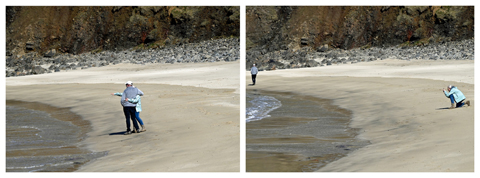
Austin offered up his prospective choices for the connected/disconnected exhibition, displaying both aspects. A Hebridean beach, divided by a stream running down to the sea, was shared in portrait and landscape to gauge views. The general view was that landscape offered more. A couple on the (same?) beach share a moment in one panel, then separate in the second while the photographer captures her scene. We all recognised that phenomenon. An age-distressed sculpture of a mother and child in a Scottish port look out to sea as they mourn lost fishermen. A comparison of colour and black and white views favoured the latter for an even more solemn, gritty image. Austin also presented a scene from Istanbul – a study of public phones, surrounded by graffiti and bikes. Are they fully connected or not? Austin’s final shot is a street art portrait of a woman’s face, a cable running down the bridge of her nose and across her lips to end in a switch on her chin, like an uncomfortable ivory carbuncle. The image is disconnected, but the cable presumably connects? A fitting photo to end on.
There will be no meeting in August. We will resume on Wednesday, 9th September, when the theme will be ‘Portraits’.