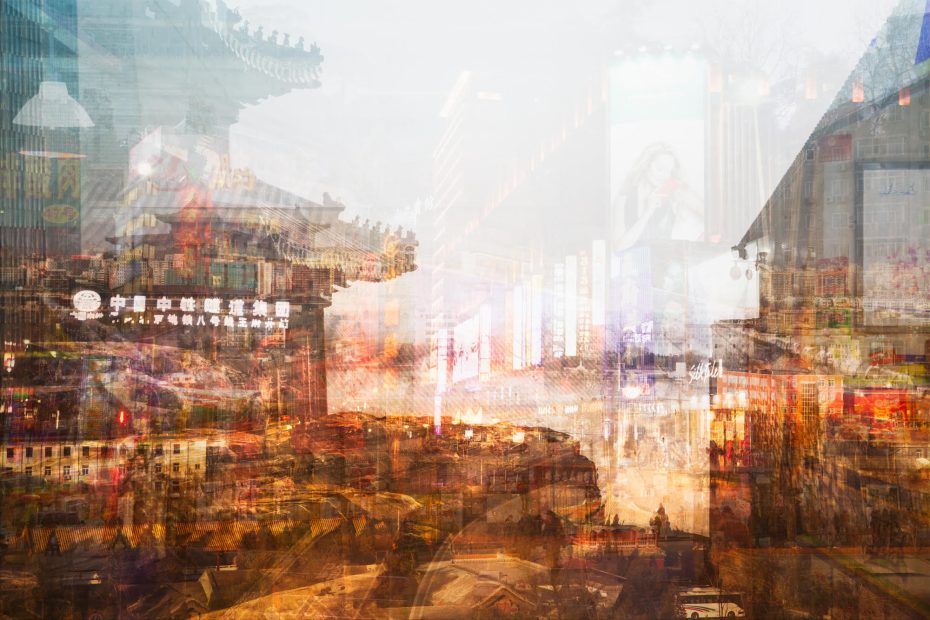
©Henry Rice
May’s meeting, dedicated to personal projects, saw four very different photographers presenting their work. All of them were about time and place, and all captured, ordered, deconstructed and re-assembled images to allow the viewer to develop a new and different understanding.
Pauline has an an ongoing project to “capture an unfolding story” of time and place. Using an intuitively developed configuration of seven tiles, she presents a set of images of a particular location. Three of those presented by her used photographs taken at the Herculaneum, while the fourth used a photograph of the Lake District. The combination of images “speak of the place” while the viewer has to fill in the context: the location is “hidden in plain sight”. The Herculaneum images of essentially two-dimensional, tiled or plastered surfaces, evoked a different response compared with the three-dimensional images of the Lake District. Pauline’s approach using a standard array of tiles opens up considerable possibilities.
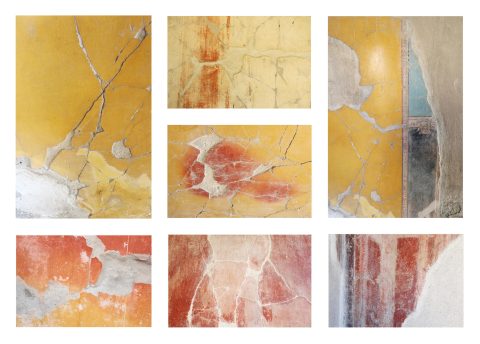
©Pauline Moon
Mark Friend is attempting to document a different time, a different place, and in a different way. He presented a series of images which explore villagers’ protests to the Sizewell C project in Suffolk. These comprise photographs of the protest signs (with no protestors in sight), photographs of Sizewell B and its associated power lines (some menacing, some beautiful) plus photographs of the leisure use of the nearby beach. The group wondered if Mark could explore a different sequencing of images, possibly revisiting the village over time. Where are the protestors? Are the protests effective?
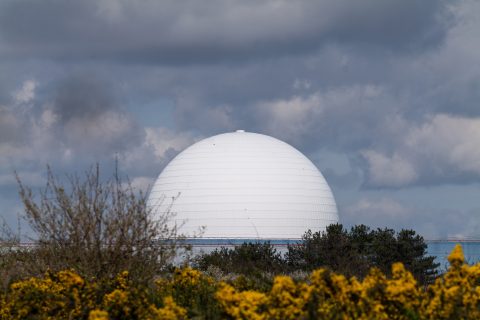
©Mark Friend
Janet has, for many years, deconstructed and collaged images of buildings (with a nod to David Hockney). Initially this was using En-prints and simply sticking them to a surface, but more recently this has all be done digitally via Photoshop. Specifically she traces over some of the images using a separate iPad, then hiding the original image. This produces a detailed outline and allows the viewer to “see” the architecture of the building more clearly. But Janet has “done architecture” and is currently applying this technique to plants, such as the palm trees at Kew, to good effect.
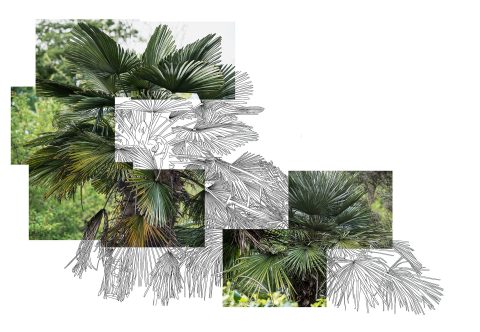
©Janet Nabney
This was Henry’s first visit to LIP Central satellite group and he presented a series of images to introduce us to his work. Henry visits a specific location (Squamish, Canada; Mexico City, Beijing etc) where he takes “hundreds of photographs” from which he selects between ten and twenty images. These are then superimposed on each other to create single, complex, literally multi-layered image. Other work includes deliberately corrupting or “bending” the meta data of an image to create a new image. In a similar vein, Henry has taken a phone photo (not a high quality one), gets ChatGBT to describe it and then use a separate and distinct piece of AI to to produce a second image based on the ChatGBT description. A fascinating exploration of way in which modern technology continues to change our perception of reality.
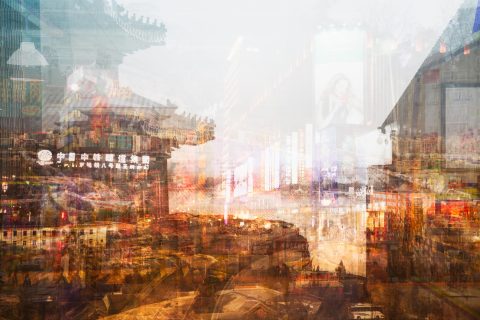
©Henry Rice
Our next meeting is on June 12 at 7 pm at the Old Diorama 201 Drummond Street, London NW1 3FE. The theme is “Still”, and there is also scope to present a personal project or series unrelated to the theme. We hope to see you and your work there, or just come along. As a special treat, it’s free of charge!